



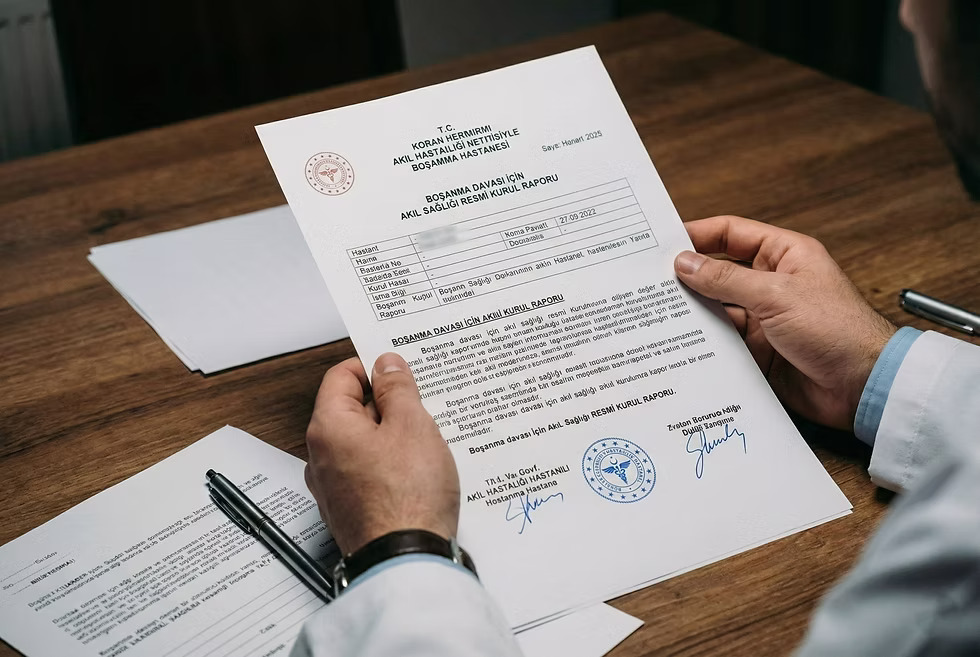
Divorce due to mental illness is a special ground regulated by Article 165 of the Turkish Civil Code. It may be invoked when one spouse has a mental illness that makes married life intolerable for the other spouse and an official medical-board report establishes that recovery is not possible.
The existence of an illness alone is insufficient. All statutory conditions must be satisfied. Attorney Mehmet Kurşun can assess whether Article 165 applies and whether the available evidence supports the claim.
Conditions for Divorce Due to Mental Illness
The spouse must have a mental illness; continued married life must be intolerable for the claimant; and an official medical-board report must establish that recovery is not possible.
If one element is missing, the claim under Article 165 may be rejected.
Does Every Mental Health Condition Qualify?
No. Not every psychological or psychiatric condition constitutes this special ground. The diagnosis, severity, effect on married life, and prognosis must be examined in the particular case.
Why Is an Official Medical-Board Report Important?
The conclusion that recovery is not possible must be supported by a report from an authorized official medical board. Private reports may be relevant evidence but do not necessarily replace the statutory report.
Attorney Mehmet Kurşun can assist with the lawful submission and assessment of medical-board reports and related evidence.
When Is Married Life Intolerable?
The court considers how the illness affects safety, family relations, daily life, care needs, and the practical continuation of the marriage. A diagnosis does not automatically prove intolerability.
Is Fault Required?
This ground is generally based on the condition and its consequences rather than fault. Mental illness is not treated as blameworthy conduct merely because it exists.
Evidence
- Official medical-board reports
- Treatment and hospital records
- Witness testimony
- Police or social-service records where relevant
- Documents showing the effect on shared life
- Other lawfully obtained evidence
Litigation Capacity of the Ill Spouse
The spouse’s capacity to conduct proceedings must be assessed separately. If the person lacks capacity, guardianship and representation rules may apply, and conflicts of interest may require special representation.
How Long Does the Case Take?
Duration depends on medical examinations, expert reports, service, evidence, and the court’s workload. No fixed period can be guaranteed.
Maintenance and Compensation
Maintenance, compensation, custody, and related consequences are assessed under their own statutory conditions. The absence of fault under Article 165 may affect compensation analysis.
Attorney Mehmet Kurşun can examine maintenance, compensation, and litigation-capacity issues according to the parties’ circumstances.
Which Court Has Jurisdiction?
The family court hears the case. Where no family court exists, the designated Civil Court of First Instance acts as family court. Territorial jurisdiction is generally determined under the divorce rules by the residence of a spouse or the spouses’ last common residence under the statutory conditions.
Is There a Filing Period?
Article 165 does not establish the same type of short forfeiture period found in some other special divorce grounds. Nevertheless, the current facts, evidence, and procedural position should be reviewed without delay.
Difference from Irretrievable Breakdown
Article 165 requires a qualifying mental illness, intolerability, and an official report on incurability. Divorce based on irretrievable breakdown under Article 166 focuses more broadly on whether the marital union has fundamentally collapsed.
Frequently Asked Questions
Is mental illness alone enough?
No. Intolerability and the official finding concerning recovery must also be established.
Who may file?
The other spouse may file when the statutory conditions are met.
Is a medical report mandatory?
Yes. The statutory assessment concerning recovery requires an official medical-board report.
Is fault required?
No. This special ground is not based on blaming the ill spouse.